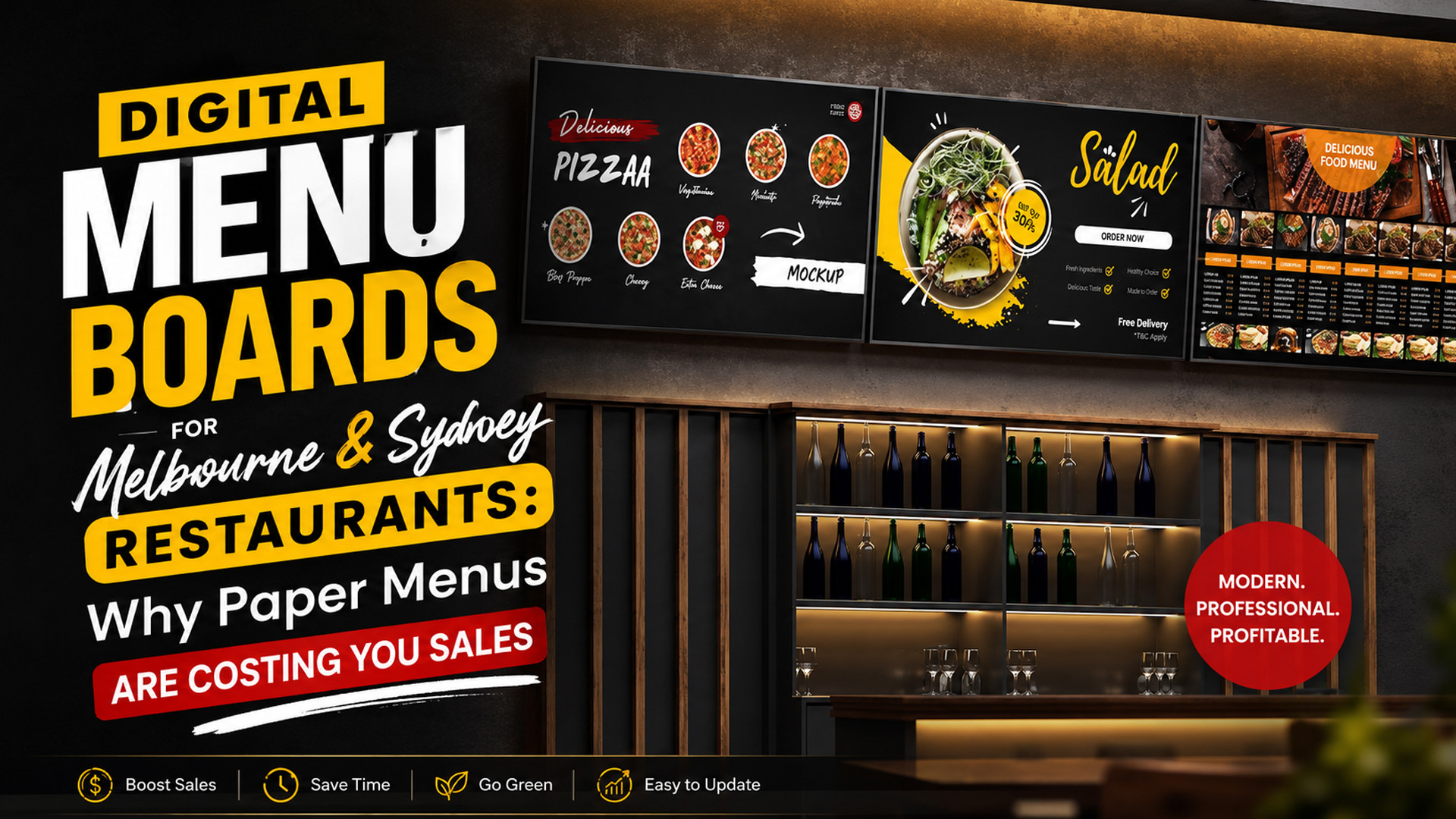
Digital Menu Boards for Melbourne & Sydney Restaurants: Why Paper Menus Are Costing You Sales
Walk into most cafes and restaurants around Melbourne and Sydney and you'll still see the same thing: a laminated menu that hasn't changed since last year, or a chalkboard someone has to physically wipe down and rewrite every time prices shift. Meanwhile, the businesses winning the lunch rush have swapped that board for a screen — one they can update from their phone in the time it takes to make a coffee.
That shift isn't just cosmetic. Digital menu boards are quietly becoming one of the highest-ROI upgrades a hospitality business can make, and the reasons come down to speed, flexibility, and — surprisingly — sales psychology.
Why Static Menus Are Holding Hospitality Businesses Back
Printed menus feel permanent, but that's exactly the problem. Every price change, seasonal special, or sold-out item means a reprint, a laminator, or a hand-written correction taped over the original. For multi-location businesses, keeping every branch consistent becomes its own part-time job.
There's also a cost to standing still creatively. Static boards blend into the background after a customer's first visit — nothing new ever catches their eye, so there's no reason to look twice at a special they might have otherwise ordered.
What Digital Menu Boards Actually Fix
Update Specials in Seconds, Not Days
Sold out of the salmon? Running a happy hour deal from 4-6pm? With a cloud-based menu board, that change goes live across every screen in the venue the moment you make it — no reprinting, no laminating, no driving over to swap a physical board.
Consistency Across Every Location
For businesses with more than one site, a centralised dashboard means every screen — whether it's in Melbourne CBD or a Sydney suburb — shows the exact same pricing and branding at the same time. No more mismatched menus between branches.
More Eye-Catching Than Paper
Movement and colour naturally draw the eye more than static print. Rotating specials, high-margin items, and seasonal promotions in a screen loop tend to get noticed — and ordered — more often than the same item buried on page two of a laminated menu.
Lower Cost Over Time
Printing costs add up: menu redesigns, laminating, signage reprints every time a price changes. A digital board removes almost all of that ongoing cost after the initial screen is installed.
| Paper Menu | Digital Menu Board |
|---|---|
| Reprint every price change | Update instantly from any device |
| Inconsistent across locations | Same content, every screen, automatically |
| Static, easy to ignore | Rotating content draws attention |
| Ongoing printing costs | One-time setup, low monthly cost |
What to Look For in a Digital Signage Platform
Not all digital signage tools are built for a busy cafe or restaurant that doesn't have an in-house IT person. Before choosing a platform, it's worth checking for:
- No technical setup required. If your team can send an email, they should be able to manage the screen.
- Works on hardware you already have. A platform that runs on a Smart TV, Fire Stick, or Android TV box means you're not buying specialised equipment.
- Auto-refresh scheduling. Screens should update themselves on a schedule, without someone manually refreshing a browser.
- Simple drag-and-drop uploads. Swapping a slide should take seconds, not a design brief.
- Transparent, predictable pricing. Look for plans that scale with the number of screens, not confusing per-location contracts.
Quick tip: Even a single screen at the counter showing your top 3 specials on rotation can lift average order value — it's one of the simplest, lowest-cost changes a venue can make.
A Tool Built Exactly for This: DisplayManagerPro
One platform we regularly point hospitality clients toward is DisplayManagerPro — a cloud-based screen management tool designed specifically for restaurants, cafes, retail stores, and clinics that need to update menus and promotions without any technical hassle.
It ticks every box above: a clean cloud dashboard, drag-and-drop uploads, auto-refresh scheduling, and secure display URLs that work on any Smart TV, Fire Stick, or Android TV box. Businesses can be up and running in around ten minutes, and it currently offers a 14-day free trial with no credit card required — a low-risk way to see whether digital menu boards make a measurable difference to your venue before committing to anything.
For multi-screen setups, plans scale from a single-screen starter tier up to multi-screen packages with priority support and content scheduling, so a venue can start small and expand as more screens go live across the business.
Getting Started Without Overcomplicating It
You don't need a full rebrand or a new POS system to make this switch. Most venues start with:
- One screen at the counter or entrance showing the daily specials board
- A simple content plan — rotating specials, prices, and a seasonal promotion or two
- A short weekly routine for updating slides, ideally the same person who already handles specials or pricing
From there, it's easy to expand — additional screens for outdoor seating, a second location, or a dedicated promotions board near the till.
Final Thoughts
Digital menu boards aren't just a trend — they solve a real, ongoing cost for hospitality businesses: the time and money spent keeping printed menus accurate and appealing. For Melbourne and Sydney venues competing for foot traffic in busy strips and shopping precincts, a screen that updates instantly and catches the eye is a small change with an outsized impact on both efficiency and sales.
If your business is still relying on laminated menus or a chalkboard, it may be worth testing the shift with a low-commitment trial before investing further — DisplayManagerPro is one of the more straightforward platforms built specifically for this use case.
Want help planning your digital signage strategy alongside your branding and online presence?
Talk to Creative Elements