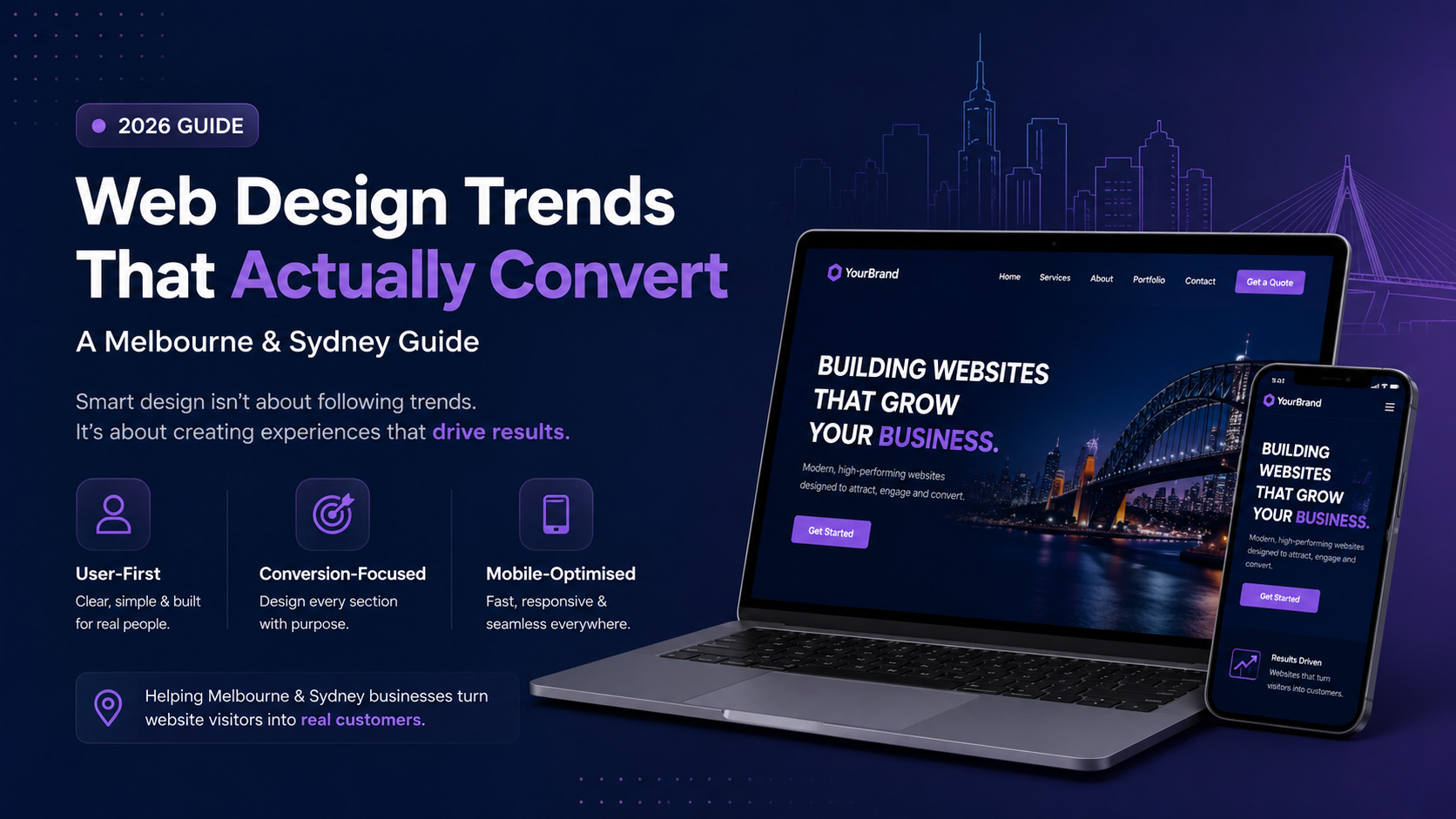
Web Design Trends That Actually Convert in 2026: A Melbourne & Sydney Guide
Every year brings a new wave of web design trends, and every year businesses waste money chasing the ones that look good in a portfolio but do nothing for conversions.
The truth is that most visitors to your website don't care about the latest animation library — they care about finding what they need in under five seconds and trusting you enough to take action.
For Melbourne and Sydney businesses competing in crowded local markets, that distinction matters more than ever. Here's a practical look at which 2026 web design trends are actually worth adopting—and which ones are simply noise.
Why Design Trends Alone Won't Grow Your Business
A visually striking website that takes six seconds to load or confuses visitors about what to click next will lose customers regardless of how modern it looks.
Google's Core Web Vitals now influence search rankings directly, meaning slow, cluttered or difficult-to-use websites are penalised twice — once by frustrated visitors and again by Google.
Key Takeaway: The best design trends improve both user experience and SEO. If they don't help visitors achieve their goal faster, they're unlikely to improve conversions.
1. Speed-First Design
The biggest design trend of 2026 isn't visual—it's performance.
Businesses are replacing heavy animations, oversized sliders and autoplay video backgrounds with lightweight pages that load almost instantly.
Even a one-second delay can reduce conversions, making website speed one of the most valuable design investments you can make.
2. Bold, Simple Typography
Large headlines and clean layouts continue to outperform cluttered hero sections packed with unnecessary text.
Your visitors should immediately understand who you are, what you offer and why they should choose your business—all within a few seconds of landing on your website.
3. Micro-Interactions With Purpose
Subtle animations remain effective when they improve usability rather than distract users.
Hover effects, button feedback and instant form validation provide helpful visual cues without slowing the browsing experience.
4. Mobile-First, Not Mobile-Adapted
Most searches across Melbourne and Sydney now happen on mobile devices.
Successful websites are designed for smartphones first, with thumb-friendly navigation, shorter forms and content prioritised for smaller screens before expanding to desktop layouts.
5. AI-Personalised Content Blocks
Modern websites increasingly personalise content based on visitor behaviour.
Returning visitors might see different promotions or recommendations than first-time visitors, creating a more relevant experience without becoming intrusive.
Remember: Good personalisation feels helpful. Poor personalisation feels invasive. Transparency always wins.
6. Accessibility as a Design Standard
Accessibility is no longer optional.
Proper colour contrast, readable typography, keyboard navigation and accessible forms make websites easier to use for everyone while improving compliance with modern web standards.
Trends Worth Skipping in 2026
- Auto-playing background videos that slow down page speed.
- Overly complex scroll-triggered animations.
- Large mega-menus with confusing navigation.
- Decorative effects that reduce readability.
These features often look impressive initially but create friction for visitors and negatively impact conversions.
What This Means for Melbourne & Sydney Businesses
Local customers often compare several businesses before making contact.
A website that loads quickly, communicates clearly and works flawlessly on mobile has a significant competitive advantage over slower, cluttered alternatives.
Google also rewards websites that combine excellent technical performance with strong local SEO signals such as suburb-focused content, accurate business information and fast-loading landing pages.
Quick Tip: Before planning a redesign, run your website through Google PageSpeed Insights to identify the biggest opportunities for improvement.
A Simple Framework for Evaluating Any Design Trend
Before introducing any new design feature, ask yourself three simple questions:
- Does it make the website faster or slower?
- Does it make the next action clearer or more confusing?
- Does it work perfectly on a mobile device?
If the answer to any of these questions is "no," it's probably not worth adding—regardless of how trendy it appears.
Final Thoughts
The highest-performing websites in 2026 won't necessarily be the flashiest.
They'll be the fastest, clearest and easiest to use.
For Melbourne and Sydney businesses, combining speed, simplicity, accessibility and mobile-first design creates websites that consistently convert more visitors into customers.
If your current website feels outdated or isn't generating enough enquiries, a professional website review may identify improvements that deliver better results without requiring a complete rebuild.
Want to know how your website is performing?
Book a free website review and receive expert recommendations to improve speed, SEO, user experience and conversions.
Get a Free Website Review